Iranian Minorities’ Human Rights Organisation (IMHRO)
Ref.IMHRO.70
09.11.2009
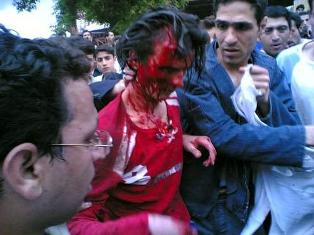
Arab Workers of Pipe factory in Ahwaz arrested after they set up peaceful process in one of main streets in Ahwaz called Naderi. They protested after many months they did not get any pay and benefits, but factory continued in same time to pay non Arab workers on time.
Witness told IMHRO minutes after protest started anti riot police started to surround attack and arrest them. Some of them severely injured during arrest.
A local Islamic clergy preacher like always accused protesters of being tools of Zionists and west.
At least 64 Arab men arrested, their where abut still not clear. Sources in factory told IMHRO many others who were present at the protest sacked and told by factory manager they could not come back to work from next week. Some workers told IMHRO this order came from Iranian security service directly.
One of the workers called Abdul Nabi, 42 years old, told IMHRO about his life “I have 7 children; this is 2 years that they did not pay me any money, but they pay the non Arab workers on time, 2 of my children are sick and we live on mercy of people, when I complain they tell me you Arabs don’t have any rights. They also threaten me to arrest all of my family if I talk about it. Few years ago I complained to the court about discrimination against the Arab workers once and they sentenced me to 2 years in prison about it. In the sentence they said you waged a war against God, they disqualified my lawyer from practising law who was an Arab too.”
IMHRO is very concern regard of treatment of Arab workers in Ahwaz. We demand their immediate release. This discrimination by Persian workers and managers which authorised through Islamic government of Iran, is inhuman and unjust, this should stop immediately.
Back Ground
Iranian government systematically suppressing Ahwazi Arabs, they are banned from education and speak in their mother tongue.
In recent month many protested in regard of long delay in paying salaries to Arab workers in Ahwaz and demanding equality at work place.
Ahwazi Arabs are banned from working in oil and Gas industry, only they can get job in low level factories. Still in those factories treated with discrimination, long delays in payment and some times after years working they don’t get any payment. They often get the hardest part of Job.
If they protest they mark as tools in hand of foreigners and charged with connection with illegal political parties.
There are no worker unions who could defend workers right and any attempt for gathering is suppressed harshly by government. After arrest they would add them to black list and then they never find any other jobs. Some end up in long term prison. Government also add their family members to black list to be banned from university and higher education.
Monday, 9 November 2009
MNN: Iran continues its religious crackdown

Iran (MNN) ― Christians in Iran are facing even more persecution. International Christian Concern has learned that the Iranian government forced the Central Assemblies of God Church in Tehran to shut down its Friday worship services. The incident took place October 30. Some fear this episode in the beginning of a new campaign of government suppression of public Christian worship gatherings.
According to reports by Farsi Christian News Network, Rev. Sourik, the bishop of the Assemblies of God churches in Iran, resolved to close the church on Fridays, the weekly Islamic day of prayer, after encountering acute pressure from the security network within the Ministry of Information.
Initially, Sourik resisted the government sanction. However, the Revolutionary Guard demanded that the church close Friday public services by October 31, and threatened to shut down all services and close the church permanently. Sourik ultimately submitted to the government's ruling out of concern for the congregation. "The announcement of the termination of the Friday services was received with shock and utter surprise, and resulted in many openly weeping in the church service," reported FCNN. The church leadership affirmed that its Sunday services will remain open.
The Assembly of God Church in Tehran is among the largest church buildings designated for public worship in Iran, a country where the majority of Christians observe their faith in underground house churches. Registered "above ground" churches in Iran have been allowed relative independence to worship freely while being closely monitored by the government. However, ICC sources fear that the closure of Friday services--a heightened trend of government coercion upon "above ground" churches--may commence.
The targeting of registered churches discloses a regression in Iran's policy of toleration toward Christians who choose to worship publicly. "I believe the main reason they closed those service is to send a strong signal to all Christians inside and outside Iran that they will not tolerate Christianity in Iran. Its purpose is mostly to intimidate," said one ICC source.
Historically, it has been the underground church, not the open public churches, that have faced the brunt of government-imposed oppression.
Iran issued no official statement explaining the reasons for its recent crackdown.
Aiden Clay, ICC Regional Manager for the Middle East, says, "We oppose Iran's resolution to prevent the Christians of the Assembly of God Church in Tehran from fellowshiping freely on Fridays, or any other day of the week. We urge Iran to respect the rights of Christians to practice their faith freely without government interference, or authoritarian rule."
Clay adds, "History has shown us that external persecution actually causes the church to grow."
Clay says that the services have had "great success in bringing in new believers,
converting Muslims to Christ, and I think Iran views that as a threat."
Saturday, 7 November 2009
Queerty: Will Iran Cancel the Death Sentences of 3 'Homosexual Conduct' Criminals?

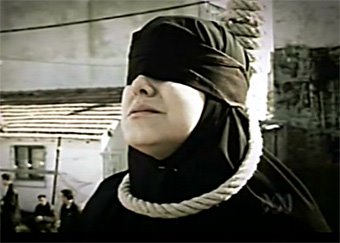
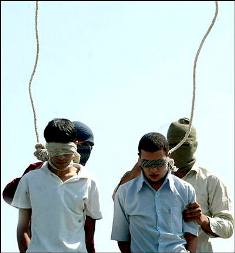
Iran's Mehdi P., from Tabriz; Moshen G., from Shiraz; and Nemat Safavi, from Ardebil, are all awaiting execution for allegedly having gay sex — when they were under 18. Guilty of "lavat" (i.e. sexual conduct between two men, regardless of penetration), the three boys do not yet have dates set for their state-sponsored murders, but one attorney fears it could happen any day, according to Human Rights Watch.
Lavat is "punishable by death so long as both the active and passive partners are mature, of sound mind, and have acted of free will" — something that not only conflicts with the boys' age at the time of the alleged "offenses," but also a gross violation of international law, which forbids, under any circumstance, the executive of juvenile offenders. Meanwhile: "In 2008, the Deputy Attorney General of Iran announced that Iranian judicial authorities would ban the juvenile death penalty for non-murder-related offenses, effective immediately, pending parliamentary approval."
VOA: Iran - Human Rights Remain A Concern

In testimony before Congress, U.S. Deputy Secretary of State James Steinberg said the possibility of Iran's developing a nuclear weapon endangers international security in multiple ways: "The danger that it [a nuclear weapon] would be either deliberately or inadvertently transferred to a terrorist or non-state actor is a very serious concern; that it would be used to threaten its neighbors would be a concern; that it would be used as a cover for it to engage in more aggressive behavior in the region.
We can think of so many reasons why this is such a grave danger that that's why we put such a high priority on preventing them getting it."But Iran's nuclear ambition is not the only concern the U.S. has about the Iranian government, said Mr. Steinberg; another is how the government treats its own people:
Iranian police sit on motorcycles as they face protesters during a demonstration in Tehran."The Iran[ian] government's terrible repression of peaceful protesters, opposition politicians and journalists following the election revealed to the world much about the character of that government and has increased its isolation."
Deputy Secretary Steinberg said that Tehran's crackdown on dissent after June's presidential election is part of Iran's broader record of human rights abuses, which has grown significantly worse throughout the past year. The U.S. State Department's annual report on human rights in Iran documents the Iranian government's restrictions of fundamental freedoms, said Mr. Steinberg, and it cites multiple instances of the government's use of torture and other forms of inhumane treatment to quell dissent.
Quoting President Barack Obama, Mr. Steinberg said, "The Iranian people have a universal right to assembly and free speech. If the Iranian government seeks the respect of the international community, it must respect those rights, and heed the will of its own people. It must govern through consent, and not coercion.
Reuters: ANALYSIS-Iran attack exposes sectarian divide, Baluch risks

LONDON, Oct 20 (Reuters) - A suicide bombing in Iran near the border with Pakistan has exposed a deep sectarian faultline in a region already destabilised by the spillover from the Afghan war, drug smuggling and nationalist insurgencies.Analysts say the ethnic Baluch insurgent group Jundollah which Iran blamed for Sunday's attack is increasingly inspired by Sunni Islamist militants based in Pakistan.
And that poses risks both to Shi'ite Iran as well as highlighting the challenges faced by Islamabad in battling Islamist groups which are now threatening Pakistan itself."An ethnic conflict has turned sectarian," said a study by the Norwegian Defence Research Establishment published in July."Extremist groups such as Jundollah are seemingly copying the practices and discourse of Pakistani movements," it said.
Fifteen Iranian Revolutionary Guards and 27 others died in Sunday's suicide bombing in one of the deadliest attacks in years on Iran's most powerful military institution.The bombing happened a week after gunmen attacked the Pakistan Army's own headquarters -- an assault which highlighted the strength of Sunni Islamist militants even as the military battles them in their stronghold in South Waziristan.Jundollah, which analysts say operates across the porous borders between Iran, Pakistan and Afghanistan, and not to be confused with a Pakistani group of the same name, denies any links to regional militant groups.
But its use of suicide bombings and Shi'ite targets -- the bombing of a Shi'ite mosque in Zahedan in Sistan-Baluchestan in May was also blamed on Jundollah -- have underpinned views it follows a sectarian rather than nationalist agenda.Its leader Abdolmalek Rigi has been quoted as saying he wants equal rights for Sunnis and ethnic Baluchis in Iran, but makes no territorial claims.In that respect, Jundollah is quite different from Baluch rebels on the Pakistan side of the border fighting for independence or autonomy for Baluchistan.
"The Jundollah seems to be more a Sunni extremist than a Baluch nationalist organisation," wrote Indian strategic analyst B. Raman in a note on the latest attack in Iran.Analysts have linked it to the Lashkar-e-Jhangvi (LeJ), an anti-Shi'ite Punjab-based group, which works closely with the Pakistani Taliban, or Tehrik-e-Taliban (TTP).
Both in turn are believed to have close ties to al Qaeda.Iran has accused the United States, Britain and Pakistan of involvement in Sunday's attack, charges they deny.
TOXIC MIX OF PROXY WARS
The Sunni-Shi'ite faultline in the region, though dating back for centuries, has been dug deep in the last 30 years.After Iran's Islamic Revolution in 1979, Pakistan's then dictator Muhammad Zia ul-Haq promoted anti-Shi'ite militant groups and hardline Sunni madrasas to contain Iranian influence.
In doing so, Pakistan won funding from Sunni Saudi Arabia, which has long battled Iran for influence in Central Asia and across the Middle East.The Soviet invasion of Afghanistan at the end of 1979 brought with it U.S. support for mujahideen fighting there, creating a toxic mix of proxy wars and regional rivalries which produced today's Sunni Islamist militant movement.
Islamic madrasas, or religious schools, sprang up along the borders of Pakistan, including in Baluchistan, many of them preaching hardline Sunni Islam in a defensive wall against the spread of Shi'ite influence from Iran.Jundollah is believed to have been heavily influenced by the sectarian agenda of these madrasas.
"The modus operandi of the latter (Jundollah) borrows much from the terrorism of the Taliban and Al Qaeda," Pakistan's Daily Times wrote in an editorial."For instance, the use of suicide-bombing carries the signature of madrasa-based indoctrination even though the Sunni Baloch of Pakistan are strictly secular..." it said.Jundollah, according to the Norwegian paper, follows Deobandi Islam, a traditionalist school of thought which first emerged in British India in the 19th century.The Afghan Taliban, created out of the same madrasa system, are also Deobandis, as are most of the Pakistan-based militant groups -- with the exception of Lashkar-e-Taiba, which follows an ideology more akin to al Qaeda's Salafist views.
BALUCHISTAN CROSS-CURRENTST
he sectarian faultline is not the only issue in the region.Pakistan has long accused India of funding Baluch rebels on its side of the border to offset Pakistani support for militants fighting in Indian Kashmir -- a charge New Delhi denies.The Afghan Taliban, according to Washington, are also based in the Baluchistan capital Quetta, home to tens of thousands of Afghan refugees who first fled after the Soviet invasion.And there are fears more fighters might flee to the region as they are driven out by the offensive in South Waziristan.
But the Sunni-Shi'ite divide, nurtured now into a fresh generation of madrasa-educated boys, may prove the most explosive, souring normally good relations between Iran and Pakistan and leaving both facing determined Sunni militant groups for whom suicide bombing is an essential part of jihad. (Editing by Jon Hemming)
The Christian Post: Campaign Launched to Free Iranian Female Converts

A ministry that supports persecuted Christians launched a campaign Thursday to press Iran to release two young female converts who have been detained for eight months in one of the most notorious prisons in the country.
Open Doors USA is calling on people to send a “respectful” message to Iranian Ambassador to the United Nations Mohammad Khazaee to request that Maryam Rostampour, 27, and Marzieh Amirizadeh Esmaeilabad, 30, be released immediately.
“Maryam and Marzieh are suffering in an Iranian prison simply for refusing to recant their belief in Jesus Christ…they truly are modern heroes of the faith,” said Open Doors USA President/CEO Dr. Carl Moeller. “We must speak out against this injustice.”
Rostampour and Esmaeilabad have been held in the notorious Evin prison – the same penitentiary that American journalist Roxana Saberi was held in – since March 5. They were originally accused of “acting against state security” and “taking part in illegal gatherings,” according to Compass Direct News.
After an Oct. 7 court hearing, however, the judge dropped the anti-state charge. But the women still face the charges of propagation of the Christian faith and apostasy.
Elam Ministries, a group that supports churches in Iran, has noted that it is rare that a judge acquits the defendants of the charge of anti-state activities. The ministry, which has been following the case closely, said it is hopeful with the unexpected turn of events.
However, Open Doors raised concern about the deteriorating health of the women. According to sources, the two women are suffering from intense interrogations and reportedly psychological pressure, including sleep deprivation.
Moreover, Esmaeilabad is enduring pain from a long-time spinal condition, an infected tooth and intense headaches. She is in need of medical attention, but reportedly none has been provided.
The two converts also believed to be sharing a cell with over 20 other women. Evin prison is well-known for its human rights violations as well as for executions in recent years.
Despite the harsh conditions, both women have refused to renounce their Christian faith. At an Aug. 9 court hearing, the Iranian judge had asked the two converts to recant their faith and return to Islam.
The women, however, refused and said they “love Jesus” and will “not recent their faith,” according to Elam Ministries. They also said they have no regrets.
Subsequently, the women were sent back to prison “to think about it,” according to a Compass Direct source who spoke with family members.
Open Doors ranks Iran as No. 3 in its 2009 World Watch List of countries where Christians suffer the most severe persecution. The U.S. State Department has designated Iran as one of seven “Countries of Particular Concern.” The CPC designation is given to the worst religious freedom violators and can lead to U.S. sanctions.
On Thursday, Open Doors USA Carl Moeller urged people to join the campaign to press the Iranian government to release the two women converts. The ministry also calls for Christians to pray for Maryam Rostampour and Marzieh Amirizadeh Esmaeilabad on Sunday, Nov. 8, during the International Day of Prayer for the Persecuted Church.
A sample e-mail letter to send to the Iranian Ambassador to the U.N. Mohammad Khazaee and to the government in Iran is available at the Open Doors USA Web site. Open Doors USA has requested that people not refer to the ministry in their e-mails.
On the Web:
www.opendoorsusa.orgMichelle A. VuChristian Post Reporter
Rights group: Iran covered up rape of detainees

By JASON KEYSER
CAIRO — An international human rights group said Friday it has documented three cases of sexual assault against detainees arrested during Iran's postelection turmoil, including one that was supported by an official report but not investigated further.
Human Rights Watch accused Iran's judiciary of covering up the abuses and called on it to immediately open investigations and prosecute those responsible.
Claims that detainees were raped by their jailers first emerged in August, deeply embarrassing Iran's clerical leadership in the midst of a crackdown on protesters who accused authorities of rigging President Mahmoud Ahmadinejad's June 12 re-election.
The New York-based Human Rights Watch said one of the cases it documented was supported by a report from the medical examiner's office, which the group said reports to Iran's judiciary. Judicial authorities, however, refused to investigate further and threatened to arrest the detainee's family if they spoke out about the abuse, the group said.
"It's shameful for Iran's government to close its eyes to official evidence of severe sexual abuse of detainees by prison authorities," said Sarah Leah Whitson, the rights group's Middle East and North Africa director.
Human Rights Watch said the 27-year-old activist was first arrested on July 26 and held for a week. The group said officers believed to be from Iran's elite Revolutionary Guard military force seized him for a second time on Aug. 19 and held him at a location in Tehran, according to his family. The activist told the rights group he was severely beaten and sodomized with a baton or a stick.
Six days later, his captors left him — bleeding, semiconscious and with his hands and feet bound — on a street in the capital where bystanders found him and took him to a hospital.
The rights group said it saw a report from the medical examiner describing, among other injuries, bruises to his buttocks and anus from blows from a hard object that were consistent with the allegations of sexual assault.
Hospital officials tried to destroy the medical report, but his father was able to make a copy, the group said, adding that the activist has since left the country.
Human Rights Watch said another young activist told the group he was raped in custody while handcuffed, blindfolded and with his feet tied.
In a third case, a 21-year-old woman arrested July 30 told the group she was
raped four times by prison guards.
Human Rights Watch named the activists, but The Associated Press does not identify rape victims as a matter of policy.
Claims that detainees were raped were first made in August by former Parliament speaker Mahdi Karroubi, who also ran in the presidential election and is part of Iran's pro-reform camp. Karroubi said at the time he received reports from former military commanders and freed prisoners that male and female detainees were savagely raped by their jailers to the point of physical and mental damage.
A government panel exonerated the regime and recommended that Karroubi himself be charged for making the allegations.
VOA: 30th Anniversary In Iran

This month marks the 30th anniversary of the takeover of the U.S. embassy in Tehran by radical students loyal to Ayatollah Ruhollah Khomeini. Fifty-two Americans were held hostage for 444 days.In Tehran, thousands of pro-government demonstrators turned out for the usual government-sponsored rally celebrating the event, and the customary chants of "Death to America" were heard.
This year, however, despite an official ban on unauthorized demonstrations, thousands of anti-government protestors also took to the streets in Tehran, in the latest in a series of protests following the disputed presidential election in June.
The unarmed demonstrators were once again met with violence by club-wielding security forces. President Barack Obama marked the anniversary with a statement noting that the seizure of the U.S. embassy in Tehran "helped set the United States and Iran on a path of sustained suspicion, mistrust and confrontation." Mr. Obama said he has made it clear that the U.S. wants to move beyond this past, and seeks a relationship with Iran "based on mutual interests and mutual respect."
For 30 years, said President Obama, "We have heard ... what the Iranian government is against; the question now, is, what kind of future it is for.""The American people have great respect for the people of Iran and their rich history," said Mr. Obama. "The world continues to bear witness to their powerful calls for justice, and their courageous pursuit of universal rights. It is time for the Iranian government to decide whether it wants to focus on the past, or whether it will make the choices that will open the door to greater opportunity, prosperity, and justice for its people."
Guardian: Danish journalism student 'arrested in Iran'

James Robinson
Iranian authorities are believed to be holding a Danish journalism student after he was arrested by the Iranian authorities as part of a crackdown on foreign reporters.
Niels Krogsgaard, 31, was reported missing on Wednesday after attending a rally organised by the Iranian Government to mark the 30th anniversary of the storming of the American embassy in Tehran.
The rally was hijacked by opposition supporters protesting about the results of the presidential election in June, won by the incumbent, Mahmoud Ahmadinejad. Three Iranian journalists, Farhad Fooldi, Behnam Nikzad, and Nafiseh Zare Kohan are also believed to be in police custody.
Overseas media have been banned from covering street protests since the demonstrations over the disputed June presidential election.
The International Federation of Journalists said that it was "deeply concerned" Krogsgaard, who it said was preparing a media project for his graduation. The organisation claimed that witness reports said he was arrested by government security forces during the demonstrations.
"Niels was arrested on Wednesday. This information comes from our affiliates in Iran," said Ernest Sagaga, spokesman at the Brussels-based journalist association. "There were two demonstrations - one pro-government and another against, and our information is that he was arrested at the latter. We have not been able to establish where he is held,"
Fooldi was about to be appear live on French news channel France24 by phone when he was arrested, according to Thomas Adamson, an anchor at the station who was due to interview him. Fooldi works as a stringer for France 24. Adamson said France 24 had been unable to confirm whether Fooldi had been detained.
The Danish foreign ministry said it had contacted Iranian authorities about Krogsgaard. A Danish foreign ministry spokeswoman added the Danish embassy in Tehran was trying to find him.
She said: "The Danish Journalism Association has said that his name is on a list of detained people. Right now we are trying to get that information confirmed."
Iranian authorities are believed to be holding a Danish journalism student after he was arrested by the Iranian authorities as part of a crackdown on foreign reporters.
Niels Krogsgaard, 31, was reported missing on Wednesday after attending a rally organised by the Iranian Government to mark the 30th anniversary of the storming of the American embassy in Tehran.
The rally was hijacked by opposition supporters protesting about the results of the presidential election in June, won by the incumbent, Mahmoud Ahmadinejad. Three Iranian journalists, Farhad Fooldi, Behnam Nikzad, and Nafiseh Zare Kohan are also believed to be in police custody.
Overseas media have been banned from covering street protests since the demonstrations over the disputed June presidential election.
The International Federation of Journalists said that it was "deeply concerned" Krogsgaard, who it said was preparing a media project for his graduation. The organisation claimed that witness reports said he was arrested by government security forces during the demonstrations.
"Niels was arrested on Wednesday. This information comes from our affiliates in Iran," said Ernest Sagaga, spokesman at the Brussels-based journalist association. "There were two demonstrations - one pro-government and another against, and our information is that he was arrested at the latter. We have not been able to establish where he is held,"
Fooldi was about to be appear live on French news channel France24 by phone when he was arrested, according to Thomas Adamson, an anchor at the station who was due to interview him. Fooldi works as a stringer for France 24. Adamson said France 24 had been unable to confirm whether Fooldi had been detained.
The Danish foreign ministry said it had contacted Iranian authorities about Krogsgaard. A Danish foreign ministry spokeswoman added the Danish embassy in Tehran was trying to find him.
She said: "The Danish Journalism Association has said that his name is on a list of detained people. Right now we are trying to get that information confirmed."
Thursday, 5 November 2009
BBC: Iran police clash with protesters

Security forces have used batons and tear gas to disperse opposition supporters in the Iranian capital, Tehran, witnesses and state media say.
Unconfirmed reports said the authorities had also opened fire.
Video footage and photos showed what appeared to be large crowds of opposition supporters being chased by security forces in riot gear.
It came as an officially backed demonstration was held to mark 30 years since the seizure of the US embassy.
Thousands were present at the anti-American rally, about 1.5km (1 mile) from where opposition supporters gathered in Haft-e Tir square.
Other groups turned out in other parts of the capital to voice their opposition to the regime.
'Attacked'
Many of the opposition demonstrators wore green scarves or bands, which have been used in repeated protests since Iran's disputed presidential elections in June.
ANALYSIS Jon Leyne, BBC Tehran correspondent
With all opposition protests banned in Iran, members of the opposition are using official government demonstrations to get their message across.
Last month, they hijacked the annual Quds Day protests, organised by the government in support of the Palestinians. There have been reports of protests at other public gatherings, such football matches.
The demonstrations have been met by an increasingly strong turnout from the police and the pro-government Basij militia. That has prevented the opposition from gathering together in any one major rally, as they managed to do immediately after the election.
The fact that the protests are continuing at all despite intense government pressure shows the depth of anger over the disputed presidential election and against the government of President Mahmoud Ahmadinejad. If the protests continue, the government's next step may be to arrest key opposition leaders.
Opposition supporters say the elections were rigged to ensure the re-election of President Mahmoud Ahmadinejad.
Riot police and pro-government militiamen had packed the streets in the centre of the capital on Wednesday, after reformist leaders had urged their supporters to attend peaceful rallies at the former US embassy.
In November 1979, 52 US diplomats were taken hostage at the embassy and held for 444 days by Islamist students in support of the Iranian revolution.
A well-known activist who was among the opposition supporters, Habibullah Payman, told the BBC's Persian service that he and others had been attacked.
"[The Green movement] came in peace and with the usual slogan of supporting peace and asking for freedom," he said.
"I saw no sign of violence or agitation in the crowd... Yet, they were attacked violently."
Opposition supporters chanted "death to dictators", as small fires burned in the street. Security forces made a number of arrests, reports said.
Obama statement
Iran's Irna news agency said protesters had attacked a bus, and that two policemen had been injured. It also reported that security forces had used tear gas in some parts of the city to disperse protesters.
Authorities have placed severe restrictions on foreign news organisations, making it difficult to verify reports.
Iran's Revolutionary Guards had warned opposition groups not to stage demonstrations on the anniversary.
Opposition leader and former presidential candidate Mehdi Karroubi briefly joined the protesters in Haft-e Tir square, according to a reformist website, Mowjcamp.
Unconfirmed reports were circulating that police had surrounded the house of another reformist leader, Mir-Hossein Mousavi, to prevent him from joining any demonstration.
Some arrests were made on Firdowsi Square, Mowjcamp reported.
At least 30 protesters have been killed in clashes and thousands arrested since June's election.
Some 200 opposition activists remain behind bars. Three have been sentenced to death.
On Wednesday's anniversary of the seizure of the US embassy, US President Barack Obama released a statement in which he urged Iran to move beyond the "suspicion, mistrust and confrontation" that had prevailed between Iran and the US since then.
"Iran must choose," the statement said. "We have heard for 30 years what the Iranian government is against; the question now is what kind of future it is for."
Wednesday, 4 November 2009
Hindustan Times: Iran hangs convicted Sunni rebel: Report

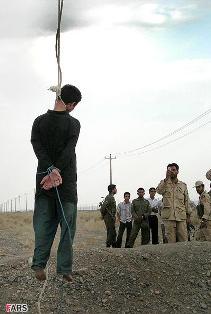
Iran hanged a member of a Sunni rebel group blamed for deadly attacks in the predominantly Shia Muslim state, the semi-official Fars news agency reported on Tuesday.
"Abdol-Hamid Rigi was hanged inside the main prison of Zahedan on Monday," the agency quoted top police official Gholam-Ali Nekouie as saying, referring to the capital city of Sistan-Baluchestan province.
Iranian media had reported that the group, Jundallah or Soldiers of God, claimed responsibility for a deadly bombing in October in Sistan-Baluchestan which killed more than 40 people, including 15 top members of the Revolutionary Guards.
Nekouie said Rigi was convicted of various charges including "kidnapping, cooperating with Jundallah and 'staging war against God'," an offence punishable by death under Iran's Islamic law. In July, 13 other members of Jundallah were executed in Zahedan on the same charges.
Earlier reports said Rigi was the brother of Jundallah leader Abdolmalik Rigi, but Nekouie said this was not the case. Iranian authorities accuse Jundallah of sowing discord between the Shia majority and the Sunni minority in Iran.
The group says it is fighting against discrimination and for the rights of the Sunnis. Sistan-Baluchestan province, which borders Afghanistan and Pakistan, is a major transit route for narcotics. It has been hit by a string of attacks and kidnappings that authorities blame on Jundallah.
IMHRO condemn treatment of Lubna Ahmed Hussein
Iranian Minorities’ Human Rights Organisation (IMHRO)
Ref.IMHRO.71
04.11.2009
Ms. Lubna Ahmed Hussein was arrested by the Sudanese government merely for wearing trousers. Having the opportunity to choose what to wear is a basic human right. This was denied to Mrs. Hussein in Sudan.
Arrests of this kind deny women of their human rights to freedom of expression and freedom from discrimination. It is unacceptable that the Government of Sudan allows such deplorable behaviour to continue.
IMHRO abhors discrimination of any kind and asks the Government of Sudan to stop these sexist arrests. The harassment of women in Sudan must stop and we declare our solidarity with the women’s rights campaigns in Sudan.
Minorities in Iran also suffer from similar discrimination with the government imposing its own dress code on the population.
Ref.IMHRO.71
04.11.2009
Ms. Lubna Ahmed Hussein was arrested by the Sudanese government merely for wearing trousers. Having the opportunity to choose what to wear is a basic human right. This was denied to Mrs. Hussein in Sudan.
Arrests of this kind deny women of their human rights to freedom of expression and freedom from discrimination. It is unacceptable that the Government of Sudan allows such deplorable behaviour to continue.
IMHRO abhors discrimination of any kind and asks the Government of Sudan to stop these sexist arrests. The harassment of women in Sudan must stop and we declare our solidarity with the women’s rights campaigns in Sudan.
Minorities in Iran also suffer from similar discrimination with the government imposing its own dress code on the population.
Monday, 2 November 2009
AFP: Iran bars dissident from collecting rights prize: organisers

GENEVA — Iran is preventing dissident writer Emaddedin Baghi from leaving the country to collect an international human rights prize, the organisers said Monday.
Baghi, an Iranian campaigner against the death penalty, is the first laureate in the 18-year history of the Martin Ennals Award for Human Rights Defenders to have been prevented from attending the award ceremony.
Previous incumbents have included another renowned rights campaigner from Iran, dissident journalist Akbar Ganji, as well as from China, Pakistan, the Palestinian territories, Nigeria, Syria, Russia and several other nations.
However, Baghi, who has headed the Committee for the Defence of Prisoners' Rights, has recorded a video message for the ceremony later Monday in the Swiss city of Geneva and a statement by him will also be read out.
"Regrettably, Emad (Emaddedin) Baghi has not been allowed to travel abroad to receive the Award," the Ennals Award said in a statement.
"He has become the first laureate in the 18-year history of the Award who has not been allowed to receive his prize in person. This is a historical precedent," it added.
The winner of the award, aimed at encouraging human rights campaigners who are regarded as at risk and in need of immediate protection, was announced in May.
Baghi, described as a writer and theologian, was praised "for his courage to stand up for his conviction that the Koran condones neither the death penalty nor arbitrary killings and detention."
The chairman of the Ennals jury, Hans Thoolen, has described him as "an exceptionally brave man defending human rights despite imprisonment and poor health."
He has served several jail terms in Iran on charges of propaganda against the regime and for having ties with opposition groups, while also receiving awards from Western countries for his work.
Ten leading human rights groups jointly award the prize, including Amnesty International, Human Rights Watch, International Federation for Human Rights, World Organization Against Torture and International Commission of Jurists.
Saturday, 31 October 2009
RFERL: Jundallah: Profile Of A Sunni Extremist Group

By Abubakar Siddique
After the October 18 suicide attack in southeastern Iran that killed at least 42 people, including elite military commanders and tribal elders, the extremist group Jundallah is suddenly at the center of international attention. Jundallah (God's Soldiers) champions the cause of Iran's 1.5 million ethnic Baluchis, who live under severe political and cultural oppression as a Sunni Muslim minority in the predominantly Shi'ite country.
Following the attack, in which five high-ranking officers of the Islamic Revolutionary Guards Corps (IRGC) were killed, the IRGC's commander accused the United States, Britain, and the Pakistani intelligence services of backing the group, and of protecting its leader, Abdolmalek Rigi.The three countries have condemned the attack and denied backing Jundallah, but Tehran continues to insist that the group had foreign support.
Immediately following the attack, President Mahmud Ahmadinejad demanded that Islamabad help Iran track down and hand over Jundallah members who Tehran believes masterminded the attacks, and who Iranian officials allege are hiding in Pakistan.
"We ask the Pakistani government not to delay any longer in the apprehension of the main elements in this terrorist attack," Ahmadinejad said. "We were informed that some security agents in Pakistan are cooperating with the main elements of this terrorist incident. We regard it as our right to demand these criminals."
Jundallah, which reportedly has been renamed the Iranian Peoples' Resistance Movement, has claimed many high-profile attacks in Iran's southeastern Sistan-Baluchistan Province in recent years.
Experts suggest that the group is a good example of how extremism can develop among the marginalized borderland communities in Southwest Asia, and how militant groups can act as asymmetrical tools in complicated relations among competing regional states.
Nationalism And Religion
Abdol Sattar Doshoki, a Baluchi political activist-turned-analyst in London, says that Jundallah leader Rigi was a "young Sunni religious devotee" who had a falling out with the Iranian government a few years ago and found support among young Baluchi religious zealots in his native region.
Jundallah leader Abdolmalik Rigi is described as a 'Sunni religious devotee.'But his violent movement has also garnered some sympathy from ordinary Baluchis who see their identity as under attack from Iran, and see Jundallah as a defender."Baluch people are being discriminated against on two specific grounds.
No. 1 is their religion. An overwhelming number of Baluchis are Sunni, and the regime is Shi'ite," Doshoki says."The second ground for discrimination is ethnicity. Most of the officials -- or I should say, maybe all of them -- are Persian speaking," in contrast to the Baluchi-speaking minority, Doshoki says. "So this friction and animosity between the regime and the people always existed. And therefore it is a kind of subliminal war going on between the regime and the people.
"Despite living along strategic trade routes atop a wealth of untapped hydrocarbon and mineral deposits, members of Southwest Asia's Baluchi minority have found it difficult to emerge from poverty and repression.More than 8 million members of the beleaguered nation call the Iranian Plateau their home. Their population spans the borders of Pakistan, Iran, and Afghanistan, with their southern reaches hemmed in by the Arabian Sea.
Some 60 percent are concentrated in Pakistan's southwestern Baluchistan Province, where they seek autonomy and have been in the grips of a violent insurgency -- their fifth in modern history -- since 2004. Their insurrection and most political movements are staunchly secular. But for the 1.5 million Baluchis living in Iran, Doshoki says, the mosque is their only real place of association, leading the causes of Sunni extremism to become mixed with Baluchi ethno-nationalism and separatism in southeastern Iran. In southwestern Afghanistan, 1 million Baluchis and their Hanafi school of jurisprudence are more in keeping with the majority.
Foreign Connection?
Since its emergence in 2003, Jundallah has taken credit for some 10 attacks, including three suicide bombing since last December and the mass kidnappings of Iranian soldiers and civilians. Iran has responded by cracking down hard on Jundallah and its perceived supporters.
Most of those arrested are summarily executed, according to human rights watchdogs. Last year, Pakistan extradited Abdolhamid Rigi, a younger brother of Jundallah's leader, to Iran, where he now awaits execution.Doshoki says that it is difficult to establish who, exactly, supports Jundallah because Tehran has never provided evidence to back its accusations that the group receives support from Washington, London, or Islamabad.Doshoki sees Jundallah as a pawn in a complicated chess game between states in the region. And he points to the strong possibility that Pakistan supports Jundallah in retaliation for alleged Indian financing of Baluchi rebels fighting the Pakistani Army through Iran.
"There is some evidence and some reasons for Iranian to believe that Pakistan is conniving with Jundallah, or at least not being harsh on them," he says. “Pakistan, I think, has got this grievance against Iran that it should not allow the Indian Consulate -- at least in Zahedan [the capital of Iran's Sistan-Baluchistan Province] -- to help the Baluch political activists or even the armed [separatist] groups including Baluchistan Liberation Front," Doshoki adds. "So there are some grievances on both sides.... I think is not very clear, really.
"In recent years Islamabad, Tehran, and New Delhi have been negotiating a nearly 3,000-kilometer gas pipeline linking Pakistan and India to Iranian gas fields. But instability in the Baluchi borderlands threatens the viability of that significant economic project.
Against Tehran
Tahir Muhammad Khan, a human rights activist and analyst who closely follows developments in Pakistan's southwestern Baluchistan Province, tells RFE/RL from the regional capital Quetta that to understand Jundallah, one has to understand the complex relationship of extremist ideologies, cross-border smuggling networks, and the ethnicities and alliances among militant organizations.
While suggesting that most information about Jundallah is based on assertions from Tehran and Islamabad that are impossible to verify, Khan says that Jundallah is an extremist Sunni organization that gets field-level support and guidance from Baluchi ethno-nationalists along the Iran-Pakistan border. And its real mission, he says, is to oppose the Shi'ite clerical regime in Tehran. He suggests that most of Jundallah's cadres are graduates of religious seminaries or madrassahs, and its core members come from the Baluchi Rigi tribe spanning the Iran-Pakistan border.
All these factors have pushed it into alliance with the Taliban in Pakistan and other extremist Sunni factions there. "Organizations, particularly armed organizations, cannot survive without major financing. When they prepare for suicide attacks it requires a lot of finances," Khan says. "So their No. 1 ally is the network led by [former] Taliban commander Baitullah Mehsud. The primary goal of this network is killing Shi'a and engaging in Shi'a bashing.
"He says the group's primary motives remain political, while it might be providing protection to smuggling rackets in return for funding. Khan sees very little motive for the Pakistani government to support Jundallah as an instrument of state policy, because "it would never like to mess up its relations with Iran."But he suggests that the Western forces based in Afghanistan might consider the Baluchi borderlands as Tehran's soft underbelly, and might see groups such as Jundallah as leverage to pressure Tehran.
Analysts suggest that the turmoil in this part of the world will rise unless regional states rethink and reconfigure their relations with their own citizens and with their neighborhood.
Subscribe to:
Posts (Atom)